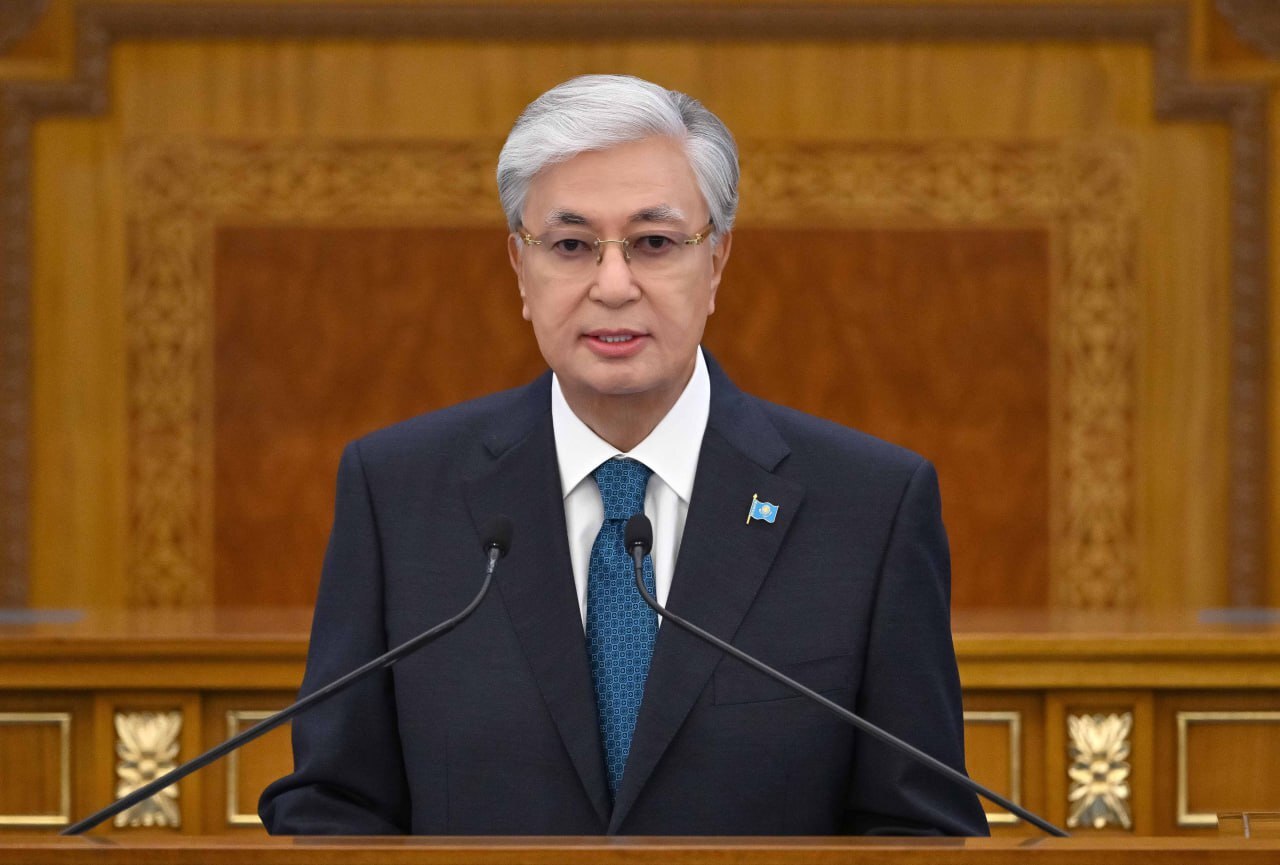
In the previous article (see "Logic of reforms-4: Strong regions - a strong nation"on the site time.kz Speaking about the spatial dimension of the presidential reforms, we noted decentralization as the key to regional development. In fact, the entire modernization project of President Kassym-Jomart Tokayev is a consistent dismantling of the super-centralized management model and the transition to a more balanced competitive system that takes into account the opinion and interests of society.
In this context, the President's proposal to create a unicameral Parliament in our country in the foreseeable future was made organically. In my opinion, it clearly fits into the general trend of modernization aimed at strengthening representative institutions, reducing the risks of personalization of power and expanding the space of political pluralism.
THE SINGULARITY POINT
This year marks the 30th anniversary of the Parliament of Kazakhstan: in January 1996, the first session of the first convocation of the new legislative branch of government was held. Over the years, a long way has been covered and a modern institution of representative democracy has been formed. But this is not just a beautiful anniversary date, but a milestone in history, which did not accidentally coincide with a new cycle of social rhythm.
In the life of any nation, any country, at every crucial stage of development, a certain turning factor always appears, which becomes the lever of essential changes that affect the future fate of the nation.
Such a turn for Kazakhstan was once the decision of the sultans Kerei and Zhanibek on the sovereignty and consolidation of Kazakh tribes, and in recent times-the choice of the presidential form of government, which determined the vector of the country's movement for more than thirty years.
When I speak of a turning point, I am not referring to one or another long stage of historical significance. The turning point is the singularity point: a key transformative moment in the life of a nation, after which the usual order of things changes.
This can be a spontaneous event that provokes an emotional public response, or a conscious decision of the authorities in a particular sector that triggers a chain reaction that leads to significant final changes in other sectors, eventually forming a new reality. Of course, these changes, which are systemic and comprehensive, always follow from the general logic of state development.
Given the trajectory of presidential reforms, at this stage in our history, we have serious reasons to believe that the next turning point may be the initiative of Kassym-Jomart Tokayev to introduce a unicameral Parliament formed on the basis of a proportional system into the system of state power – as a decisive stage on the way to a Fair Kazakhstan.
It is no coincidence that the Head of State called this step fateful in a recent interview with the Turkistan newspaper.
The current parliamentary reform is a natural continuation of the political transformation launched in 2019 and aimed at strengthening the role of Parliament by redistributing powers between the branches of government, institutionalizing political competition through simplifying party registration and introducing a parliamentary opposition.
That is why the Head of State stressed that this reform of the supreme representative power will be a logical continuation of all previous reforms, including the reform of the presidential power.
In this context, the proposal for a possible transition to a unicameral Parliament is not just another measure to optimize public administration, but a key part of a large – scale modernization strategy based on the concept of "Strong President – Influential Parliament – Accountable Government".
The definition of "influential" in relation to the Parliament in the logic of modernization changes means the emergence of a new balance in the system of state power, providing an effective system of checks and balances, which will be backed by a real political force in the face of competing parties. This will fill the term with real content.
Moreover, it is obvious that the formation of a unicameral Parliament does not mean that there will be a simple mechanical reduction of the Senate and the preservation of the Mazhilis in its current format. We are talking about the unification of chambers and the formation of a fundamentally new model of representative power, which means a new system of political equilibrium that excludes the hypertrophied influence of formal and informal centers of power.
The new unified Parliament, having party and electoral support in the regions, concentrating the resources of legislative initiative and relying on independent maslikhats, will become not only an influential counterweight to the executive power, but also a key factor in activating party building and the stability of the political system that can adapt to the changing needs of society.
Constitutional consolidation of the new format of the supreme representative power will become a kind of symbolic watershed, drawing a line under the key stage of transformation of the political system.
This will be an important political signal of the completion of "technical" reforms, the transition period in general, and a decisive turn towards a more transparent, more competitive, and more balanced government structure in Kazakhstan.
FORWARD TO THE PAST?
Does the creation of a unicameral parliament mean a return to the traditions of the Supreme Soviet of the early 90s?
To answer this question and understand the logic of the presidential initiative in the context of the triad "Strong President-Influential Parliament – Accountable Government", we need a panoramic view of the evolution of representative power in Kazakhstan.
We will not go too far into history here – it is just as unproductive to look for a direct continuity of our Parliament with the Kurultai of the Kazakh Khanate as it is to consider the Anglo-Saxon Witenagemot as a prototype of the British Parliament.
After all, the first model of parliamentarism in the modern sense, not only in England, but throughout the world, was the regularly convened parliament of Edward I Plantagenet, which went down in history as an Exemplary Parliament and became the forerunner of the bicameral model, approved in canonical form in the XIV century under Edward III.
As for modern Kazakhstan, here the origins of representative power appeared at the time when it was part of the USSR, where historically its own experience and traditions were formed, which seriously deviated from the world axis.
The ideas of separation of powers, parliamentarism, and competitive democracy were completely alien to the majority of the population of the Russian Empire even before the October Revolution, and after it they were completely perceived as symbols of hostile discourse.
Therefore, the first form of people's power that was understandable and close to the people was the Soviets – a spontaneous form of self-organization of workers during mass strikes, and then the armed insurrection of 1905.
The Soviets showed their power as an aggregator of popular discontent against the current government – and played a major role in uniting the rebellious masses in 1917. After October, they became mass organs of the " dictatorship of the proletariat and the poorest peasantry."
However, this ancient model of communal self-organization of the peasant world, which proved itself well as a means of consolidation in the struggle against the class enemy, did not stand up to competition when the time came for creative state management.
As a result, the Soviets, having helped to seize power, were unable to become its real focus and were pushed back by the well-organized party bureaucracy into the zone of formal functioning. In fact, the power of the Soviets has become a symbolic simulacrum, a political showcase of the country to which they gave their name.
This is due to the institutional inability of the Soviets to manage centrally. The electorate of local Soviets was dispersed into territorial districts, and the Supreme Soviet of the USSR, proclaimed the highest authority in the country, "elected by universal, equal and direct suffrage", in fact had no real electorate at all and was forced to rely on the power resource of the Communist Party. The same system was cloned in the national republics, and the Supreme Soviet of the Kazakh SSR, formed on the basis of the Constitution of the memorable 1937, was no exception.
The system began to change almost seventy years later, just before the collapse of the exhausted USSR. Just as at the beginning of the century, in the second half of the 80s, the Union accumulated a concentration of an explosive mixture of two components: the spontaneous unwillingness of the lower classes to live in the old way and the inability of the upper classes to rebuild and offer new rules of accommodation for everyone. The answer to this challenge was the revival of Soviets in the national republics, which received a second life in a favorable environment of instability of the central government.
In March 1990, the first alternative elections to the Supreme Soviet of the Kazakh SSR were held. It was a romantic time of the formation of Kazakh statehood. The Supreme Council of the XII convocation adopted the most important documents – the Declaration of State Sovereignty, the Constitutional law on State Independence, the first Constitution of independent Kazakhstan, and finally nominated the first President.
However, despite the general desire to improve the life of the people, the Supreme Soviet, which retained all the ancestral features of the former Soviets, now, in conditions of uncertainty, when the old rules no longer worked, and the new ones were still in the nascent stage, inevitably turned out to be a brake on the path of tough but vital reforms on which the state's formation depended.
Let me remind you of the situation in the early 90's.
The public mood is a mixture of enthusiasm for change and fear of the chaos of an incomprehensible future. The euphoria of newfound freedom and national revival was drowned out by falling living standards, uncertainty about the future, and the aggravation of social contradictions. People who only yesterday seemed to live in relative contentment under socialism, but now survived in a free market, it was difficult to accept this side of the new reality.
The country is experiencing a severe economic crisis, primarily caused by the decline of the long-obsolete socialist economic system, which required building a completely new system based on market mechanisms from scratch. The future of the newly gained independence depended on this, which at that time was declared, but actually swung on the unstable scales of history, on one side of which was the format of the supreme power, on the other – the formula of economic development.
This was a bifurcation point, which in fact depended on overcoming not just the path that Kazakhstan would take, but its very existence as an independent entity. And it is precisely at this point that the key to understanding the emerging contradiction between the Supreme Soviet and the first President, which led to a crisis between the representative and executive authorities, is revealed.
The 1993 Constitution, which gave broad powers to the Supreme Soviet, prevented the President from fully exercising the functions of the Head of State to promote unpopular but vital reforms. At the same time, the Supreme Soviet was unable to formulate a productive national development agenda that would meet the long – term interests of the state, primarily because it could not go against its constituents, who in the mass could not accept market relations that were incomprehensible and terrible for their minds.
In the critical conditions of dual power, when every month of postponement of reforms was worth the lost decades, Kazakhstan was in dire need of a single-handed leadership that could ensure the manageability and stability of the fragile state and lead it out of the crisis.
As a result, deputies of the Supreme Soviet of both convocations resigned before the end of their term: the XII convocation – by self-dissolution, the XIII and the last-was recognized as illegitimate by the decision of the Constitutional Court. On this "unlucky" number for itself, the Supreme Soviet, as a form that has outlived its usefulness, ceased to exist.
By the way, in 1994 I worked in the apparatus of the Supreme Soviet of the XIII convocation – and I witnessed the confrontation between the Old Square and the New One. I remember how I, a young man at that time, was literally struck by the atmosphere of universal intoxication with the air of freedom without borders and rules. This romantic spirit bubbling up in the smoke-filled offices of the Supreme Soviet seemed surprising to me after the dismal Soviet unanimity – although it was doubtful that a boat in which everyone rowed in their own direction would be able to reach the shore.
The deputies, inspired by their personal victories in a sharp electoral struggle, brought to power an uncontrolled emotional element, not restrained by either party discipline or a well-established sense of justice, which is generally characteristic of societies in transition. Unproductive competition with the executive branch often became the main focus of the legislative process, and an understandable desire to avoid unpopular decisions made it difficult to pursue long-term development-oriented policies.
At the same time, it was an important step towards the formation of a new political culture. The Supreme Council of the XIII convocation, elected in 1994 under the updated legislation and working on a professional basis, was the first experience of a permanent parliament.
However, in the absence of a tradition of separation of powers – and legal mechanisms to protect against claims to political dominance-the populist intentions of deputies led to a violation of the constructive balance between the branches of government at a critical moment in the formation of statehood.
For successful development, Kazakhstan needed a new constitutional architecture based on a clear delineation of power functions, a strong presidential institution and a stable professional parliament, which was laid down in the 1995 Constitution.
BALANCE FORMULA
The establishment of a bicameral Parliament in the new Constitution was an important mechanism for stabilizing the public administration system, which insured against impulsive decision-making. Elections to the first convocation of the Parliament were held in December 1995.
The bicameral model provided a balance through checks and balances, removing the issue of the power crisis from the agenda, and also provided a balance between national and regional interests. The Senate ensured the strategic stability of the state policy and the representation of the regions in the center, while the Majilis ensured political competition and sensitivity to public sentiment. As a result, a balanced bicameral Parliament quickly provided the legal foundation for the country's recovery from the crisis of the 1990s, becoming one of the pillars of political stability, public dialogue and harmony.
Over the past thirty years, more than 3,400 laws developed and adopted in Parliament have covered all key areas of public life: the economy and finance, the judicial and banking system, the social sphere, internal politics, regional development, science and culture, digitalization and artificial intelligence. Much work has also been done to strengthen external relations: more than 1,400 ratified international agreements have ensured Kazakhstan's integration into the global legal and economic system, consolidating its status as a responsible and predictable partner.
Over the past thirty years, the Parliament has shown itself to be a consolidating force, capable of ensuring the stability of the governance system, predictability of the rules of the game and the preservation of the existing order.
The upper house of Parliament played an important role as a stabilizing institution in the system of State power. In this capacity, the Senate is focused on three key tasks.
The first is to be a guarantor of the evolutionary development of the political system. In the difficult years of independence, with a sharp change in the economic model, with a deep transformation of institutions, the Senate became one of the key forces that kept the course and did not allow to go aside on the path to democracy, market economy and the rule of law.
The second is the continuity of the legislative process and its quality in the context of rapid reforms. During the periods when the Mazhilis was dissolved or re-elected, the Senate assumed the functions of Parliament and passed laws that could not be postponed. This was the case, for example, in the summer of 2007, when during the absence of the Mazhilis, the Senate adopted dozens of important laws, ensuring the non-stop work of the state. So it was in the spring of 2023, during the early elections to the Mazhilis.
The third is the role of the Chamber of Regions. All regions, capitals, and cities of national significance are equally represented in the Senate. This makes it possible to take into account not only the "average temperature in the country", but also the real needs of villages, rural areas, border areas, industrial centers in the legislative process and the formation of the republican budget.
A whole infrastructure of the regional dimension has been created here: the council for interaction with maslikhats, the Onir deputy group, regular visits of senators to the regions, meetings with the population and local deputies. Through these mechanisms, the Senate did not just control the implementation of laws. He heard regional concerns and hopes, took them into account in the legislative process and helped build a more balanced regional policy.
Along with the regions, the Assembly of People of Kazakhstan is also represented in the upper house. Through the ANC quota, the Senate controls the interethnic harmony agenda.
Of course, the activities of the upper house are not limited to three main areas. Over the years, the Senate has also become an intellectual center where proposals on topical issues of the functioning of the state are formed. Several expert platforms are actively working under the Senate: the expert club, the Senators ' Council, the Inclusion Council, and the Ulttyk Mudde dialogue platform. These expert formats are not self-contained, but are feedback mechanisms. Public inquiry, professional assessments, and regional issues are not "stuck" in the information space – they are translated into the language of laws, amendments, and parliamentary recommendations.
The Senate has become one of the key drivers of the Sustainable Development Goals agenda. The Parliamentary Commission for Monitoring the SDGs, which includes representatives of both chambers, has become a platform where sustainable development is seen as the foundation of national security and quality of life.
The Senate of Kazakhstan has played and continues to play a key role in holding the Congress of Leaders of World and Traditional Religions, which has become a unique global platform for interreligious and intercultural dialogue. Today, the Congress has become one of the international institutions of "spiritual diplomacy", actualizing the problems of dialogue of religions, values of peace and unity of mankind.
A separate word about the main asset-human capital.
Since the time of Romulus, the Senate has traditionally been a council of experienced citizens with spiritual and political influence. Without a doubt, this tradition lives on in the Senate of the Parliament of Kazakhstan – and not least the role of the upper chamber as an arbiter, as an institution of moderation and balance was ensured by the reputation and life experience of our senators. Therefore, the history of the Senate is also the history of the people who gave it a human dimension and moral authority.
Of course, first of all, this is Kassym-Jomart Tokayev, under whom the upper house became a highly professional and influential center of lawmaking. The Senate accompanied large-scale reforms, ensured the balance of power branches with its authority, actively developed inter-parliamentary cooperation, representing Kazakhstan at the UN, OSCE, and inter-parliamentary assemblies.
Особое место в плеяде сенаторов занимает Abish KEKILBAYEV, people's writer, statesman, who was the voice of national modernization, occupies a special place in the galaxy of senators. His active position regarding the high status of the Kazakh language, the cultural heritage of the people, and the spiritual foundations of independence set the bar for the content of parliamentary discussions.
Omirbek Baigeldi, the first chairman of the Senate, had a powerful influence on the formation of the Senate. At a time when parliamentarism was just getting back on its feet, it managed to turn the upper house into a creative platform that provided a thoughtful transition to the market, the rule of law and a new political culture. He made a significant contribution to the basic legislation on the judicial system, the fight against corruption, and civil society institutions.
One of the key figures in the history of modern parliamentarism was Oralbay ABDYKARIMOV. Having headed the Senate during a period of large-scale transformations, he organized high-quality regulatory support for reforms, including the adoption of systemic laws in the judicial, financial and social spheres. With his participation, a solid legislative framework was laid, which determined the further development of the country.
Kuanysh Sultanov became the embodiment of the professionalism of the upper chamberКуаныш СУЛТАНОВ. His approach combined the deep political thinking of the academic school with human charm. While working in the Senate, Kuanysh Sultanovich headed key committees, including the Committee on Foreign Relations, Defense and Security, where he managed to unite the strongest political figures and ensure their well-coordinated, professional work.
Символом интеллектуальной глубины Сената был Zhabaykhan ABDILDIN, one of the greatest thinkers of modern Kazakhstan, founder of the Kazakh school of dialectical logic, Vice – president of the Academy of Sciences of the Republic of Kazakhstan, public figure and mentor of a whole generation of scientists, was a symbol of the intellectual depth of the Senate.
Among those who stood at the origins of independent Kazakhstan is Zinaida Leontievna FEDOTOVA, Chairman of the Senate Committee on Legislation and Judicial Reform during the important years of state construction.
This series can go on and on. Senators of Kazakhstan with their experience, professionalism and wisdom made an outstanding contribution to the development and strengthening of Kazakhstan, making the upper house one of the main factors of state stability and continuity of traditions.
In the renewed political architecture of Kazakhstan, the Senate remains an authoritative mechanism of political balance, an institution of central power representing the interests of the regions, and an intellectual expert center.
As President Kassym-Jomart Tokayev emphasized, the Senate, which was created in difficult and unstable political conditions, has adequately fulfilled the historical mission of ensuring the stability of state construction over three decades, becoming the most important mechanism and guarantor of the implementation of both the legislative process and other key reforms.
UNICAMERAL AND MULTIPARTY
The old metaphor "the state is a living organism", which goes back to Plato and was formulated by the author of the term "geopolitics" Rudolf Chellen, if we discard the spatial aspect, implies that it is a complex interconnected system that requires the coordinated work of all elements, which develops in response to crises, is able to grow and change depending on internal needs and environmental conditions wednesday. Growth and change are life, stagnation and stagnation are death.
For thirty years, much has changed in our living organism, we have outgrown the previous norms and are in the process of forming new ones. The current growth crisis, which has been answered by the systemic reforms of recent years, is radically different from the crisis of the formation of statehood. At that time, it was a question of forming a stable viability of the state at the cost of strict unity of command. In the new conditions of the social order for the decentralization of power, it is necessary to rethink the system of checks and balances and change the balance formula.
The stabilizing function of representative power today requires combining the potential of both chambers into one powerful fist, a unicameral Parliament, as an influential counterweight to the executive power, expressing the full range of opinions of all social groups of the people of Kazakhstan. The latter is the cornerstone of the parliamentary reform, because the main customer of changes this time is not the government, as before, but the people.
After all, the people and society have also grown in 30 years, our identity has become stronger, our values, political culture and worldview have changed – from the former Soviet people who were afraid of market changes, the people of Kazakhstan have formed not only as a carrier of sovereignty, but also as a political subject.
And the Head of State, elected by these people, who realized their subjectivity, clearly responded to the social order, proposing to reformat the legislative power with an emphasis on strengthening its representative function. Hence the party principle of forming a new Parliament proposed by the President of the country.
Without idealizing or absolutizing the role of political parties, we must recognize that this is a key tool for implementing representative democracy and universal suffrage as a really working form of social contract between citizens and the authorities, the only possible way of its long-term legitimation.
At the same time, from the point of view of party decentralization, which is relevant for Kazakhstan with its undeveloped party field, where one party dominates, a proportional system is preferable to a majority system. According to the so-called Duverger law, the system of majority representation leads to a sharp decrease in the chances of new small parties to get into Parliament. At the same time, the proportional representation system promotes multiparty relations, which means that the interests of various groups of the electorate are maximally covered.
At the same time, I will not reveal a secret by saying that the political role of parties in Kazakhstan, despite the reforms and the subsequent appearance of new actors in the party field, is still generally low. Until recently, our parties, with the exception of Amanat, were in a hibernation mode during the inter-electoral period, and even traditional electoral activity was energy-saving.
The emergence of an influential unicameral Parliament that concentrates the full potential of representative power in its hands will be a powerful incentive to awaken the ambitions of new political leaders and a wide-open window of opportunity for the formation of a competitive party democracy. Without strong political parties that represent the interests of their electorate and are integrated into the system of a single representative body, it is impossible to build a truly Fair Kazakhstan.
DIGITAL DEMOCRACY
Perhaps many people found it unusual that the Head of State announced parliamentary reform in his Address dedicated to solving urgent problems through digital transformation. However, it wasn't really a coincidence. The upcoming deep modernization of representative power is impossible without synchronization with new technologies that have expanded our reality.
Revealing this aspect of the reform, Kassym-Jomart Tokayev stressed that " digitalization and the introduction of artificial intelligence will definitely change public administration systems around the world," and we also do not intend to lag behind the trend of the era.
In principle, Kazakhstan is quite deeply immersed in the topic. Today, no state or quasi-state body can do without artificial intelligence in one way or another.Samruk has even included the neural network in the board of directors – and with the right to vote. Another thing is that this is unusual and an inexperienced person may ask: how can AI be connected with such a traditional and deeply conservative institution as the parliament? After all, people's fates are decided here, not corporate issues.
However, let's not forget that we have successfully integrated e – government into our lives before many others, and we don't even think about how it has changed our lives. But if somehow we were to go back to what we were before, we would feel a huge difference.
E-government is also within easy reach of an e-parliament. The development of the e-parliament began in 2023, there is a conceptual understanding of the processes, and technically, I think we will soon be ready to test it in full.
But, of course, in the case of the parliament, it's not just a matter of habit or purely technical decisions. No matter how bold it may sound, we are literally standing on the threshold of a digital democracy, due to the callous honesty and transparency of mathematical algorithms, which greatly reduces the distorting influence of the human factor. Of course, it is a tool, but a tool that becomes an integral part of reality, complementing and changing it.
Today, parliamentary systems around the world are undergoing a new stage of transformation. And this transformation is not due to ideologies or political crises, but to the qualitative leap of the technological revolution, which changes the very nature of politics.
In the past, the representative function of Parliament was based on traditional forms of communication. Voters gave deputies "instructions", and parliamentarians represented the interests of the electorate in the legislative body and voiced the corresponding tasks to the government.
Today, everything is changing. Parliamentary activity takes place in a very different environment than it did thirty years ago.
The digital age is blurring the boundaries between society and government. Anyone can create an agenda through social networks, set a discussion, contact ministers and akims – and express their position directly and instantly. The public discussion has moved to a digital space that lives in real time.
The report of the Inter-Parliamentary Union "Use cases for AI in parliaments" showed that digital channels have dramatically accelerated the feedback mechanism, and the world's parliaments are moving from static representation to models of"permanent dialogue". In a number of countries, parliamentarians use digital public opinion panels, request tracking systems, and algorithmic analysis of thematic requests.
All this inevitably changes parliaments. A deputy who knows how to work with digital tools can actually build a direct and continuous dialogue with society-faster, wider and deeper than ever before. Representation becomes not only a legal status, but also a communication competence, without which a modern politician loses touch with society.
The second line of change is artificial intelligence.
Today, big data allows you to track the implementation of the law almost in real time. Digital systems with artificial intelligence are emerging that can automate the analysis of regulations, model the consequences of regulation, identify gaps and suggest adjustments.
There is a common logic in the global experience of e-parliaments. Parliaments are no longer just a meeting room. They are becoming complex ecosystems where data, digital technologies, and political responsibility connect. The quality of representation is no longer measured solely by the number of parliamentary mandates. It is measured by the speed of response to public requests, transparency of decisions, availability of information, and the ability of Parliament to work in the language of citizens, and not just in the language of legal formulas.
It cannot be ruled out that in the coming years, large corporations that own powerful AI platforms will initiate bylaw regulation or even offer ready-made regulatory solutions. This requires a new architecture of interaction between the state, society and the technology sector.
The Parliament of the near future should combine speed and quality, openness and professionalism, political competition and technological competence. It is the digital parliament that can become the basis of this new model.
The Head of State set the task of turning Kazakhstan into a fully digital country in the next three years as one of the most important tasks of the new stage of development. The President of the country stressed that it depends on what place our nation will take in the future world. And the new single Parliament, in its public status, should become the center and model of digital democracy.
FORM AND CONTENT
Parliamentary reform is precisely the nerve node that can trigger essential changes: if properly connected, all the power lines of political commutation lead here and from here.
This is by no means a change in the facade, but a strengthening of one of the supporting structures of the building of power, moving towards a more influential, transparent and efficient system, where key decision-making mechanisms are transparent and understandable to society. It should include mechanisms of control over the executive branch, an effective but not paralyzing system of checks and balances.
The success of the parliamentary reform will be determined by key details of the institutional design of the new Parliament as a powerful political force. Of course, we cannot predict exactly what the new architecture of representative power will be, but we can, based on the general logic of the tasks we face, indicate the need for some key assembly points.
This is primarily a strengthening of the committee system. A unicameral Parliament will require strong specialized committees with great powers, including the right to initiate hearings, investigations, and summon ministers and mayors. Permanent specialized offices, analytical and legal services are also required.
A powerful tool will be the digital platform e-parliament, possibly integrated with e-government and e-otinish. It will allow to deepen and accelerate the processes of lawmaking, including end-to-end analysis and maintenance of draft laws from "a" to "z", identification of conflicts of interest, corruption risks and contradictions with existing legislation. The digital Parliament will ensure transparency at all stages of lawmaking and will be able to form an up-to-date agenda based on requests and monitoring of the mood and situation in the country.
The transition to a unicameral Parliament will require the creation of compensatory mechanisms to replace the functions of the Senate as the chamber of regions, taking into account their interests at the national level. In addition to the relevant committee on regional development, which the Head of State mentioned, the Council of Regions under the Parliament in the format of an advisory body can become such a mechanism. In addition to parliamentarians, it may include representatives of regions-the chairmen of maslikhats and public organizations.
This will help to ensure that the maslikhats are not lost and will not be left to cook in their own juice. They will be integrated into the new architecture of representative power, which will create a direct vertical feedback: population-maslikhat – national Parliament.
The formation of the highest representative body on a competitive proportional basis will lead to a domino effect. A multi-party Parliament will create prerequisites for a more complete and effective representation of the interests of the electorate. Parties will be forced to "aggregate" the disparate interests of social groups with no clear political representation into specific programs in order to gain votes. To retain the electorate, the parties will create permanent feedback channels: local branches, public reception offices, and online platforms for collecting proposals.
A multi-party Parliament will provide a competitive legislative environment: draft laws will pass through party filters – debates, coalition agreements, and compromises between different ideological platforms. This will seriously affect the quality and legitimacy of the decisions made.
There will be powerful parliamentary parties, and with them – a proactive legislative initiative in terms of the interests of the party electorate. The Parliament will become a platform for competitive political discussion. Parliamentary debates will become the main political arena of the country, where different views on the future of Kazakhstan will collide in real time.
Of course, all this will require time, political will, the maturity of the parties, their willingness to compromise and social consensus, and the conscious activity of the voters. But the result is worth it. The introduction of a real multi-party Parliament in Kazakhstan opens a portal to a new political dimension: the creation of a sustainable, inclusive and responsible political system, where power is delegated from the bottom up, ensuring that the interests of all social groups are represented.
TOWARDS THE FUTURE
The new model will change the philosophy of parliamentarism in Kazakhstan. The Parliament will no longer be able to remain only a legislative body. It is designed to become a center of public dialogue, where people are heard, understand the needs of society and form new meanings of state development. In general, a professional parliament of the 21st century should be multi-party, compact, high-tech and non-stop integrated into the living fabric of public life.
The world is entering an era where the contours of political institutions, the logic of governance, and the mechanisms of citizen participation are changing. Our country is also a part of this process. In modern times, a renewed Parliament should become the central pivot of the balance of the entire configuration of power. Here the key objectives of the political system will converge and the sustainable development agenda will be articulated, not abstract, but real, understandable to people, based on their needs and expectations.
Therefore, the parliamentary reform is primarily about our values.
That an influential Parliament will become a pillar of independence and sovereignty. Multiparty relations are the key to political competition and justice for all. A stable balance within the government will lead to stability without stagnation and progressive development. The new system of checks and balances will stand in the way of corruption and nepotism, guarantee the protection of human rights and democratic development of the country. All together, it will ensure a prosperous life for everyone.
These values can be called Kazakhstan's dream. Parliamentary reform is a road map leading to it. Tomorrow's dawn is ahead. And a single strong Parliament is a broad step towards the future. Towards the dream.
Maulen ASHIMBAYEV, Chairman of the Senate of the Parliament


